
The hyperscaler flip: buybacks went to zero, the bond desk took over — except at Microsoft
Every figure below traces to filed cash-flow statements: Alphabet 10-Q
0001652044-26-000071 (filed 2026-07-23), Amazon 10-Q 0001018724-26-000026
(filed 2026-07-31), Meta 10-Q 0001628280-26-050705 (filed 2026-07-30),
Oracle 10-K 0001193125-26-277521 (fiscal year ended 2026-05-31), Microsoft
10-K 0001193125-26-323660 (fiscal year ended 2026-06-30). Research, not
investment advice.
For a decade the hyperscaler capital-return story was simple: enormous buybacks, funded from operating cash, quarter after quarter. The last four quarters of filings show that machine being switched off — and a different machine being switched on. Three of the five big AI spenders have taken share repurchases to zero. Four of the five have turned the bond desk into a primary funding source, raising roughly $210 billion of debt in their latest reported periods. One company did neither.
The buyback fade
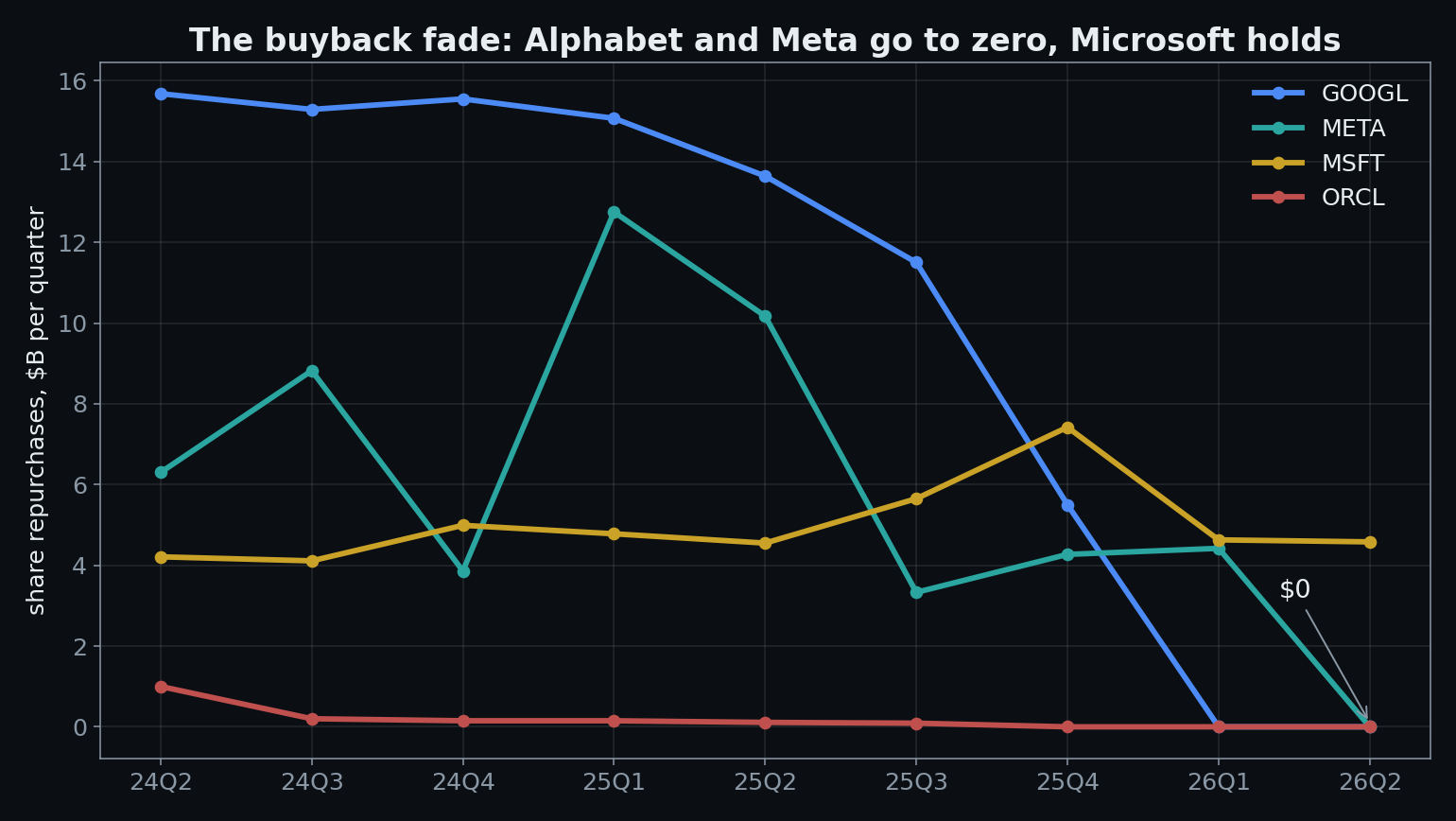
Alphabet ($GOOGL) repurchased $45.7 billion of stock in 2025 — and $0 in the first half of 2026, against $28.3 billion in the same period a year earlier. The line in the filing reads simply: "Repurchases of stock — 0."
Meta ($META) bought back $26.25 billion in 2025, $22.9 billion of it in the first half. First half of 2026: $0.
Oracle ($ORCL), which spent tens of billions a year on repurchases in the 2010s, bought back $95 million in the entire fiscal year ended May 2026 — a rounding error against its $5.8 billion of dividends.
Amazon ($AMZN) never ran a buyback program in this cycle, so it had nothing to cut.
And Microsoft ($MSFT) just kept going: $22.3 billion repurchased in the fiscal year ended June 2026, spread steadily across all four quarters, exactly as in prior years.
The bond turn
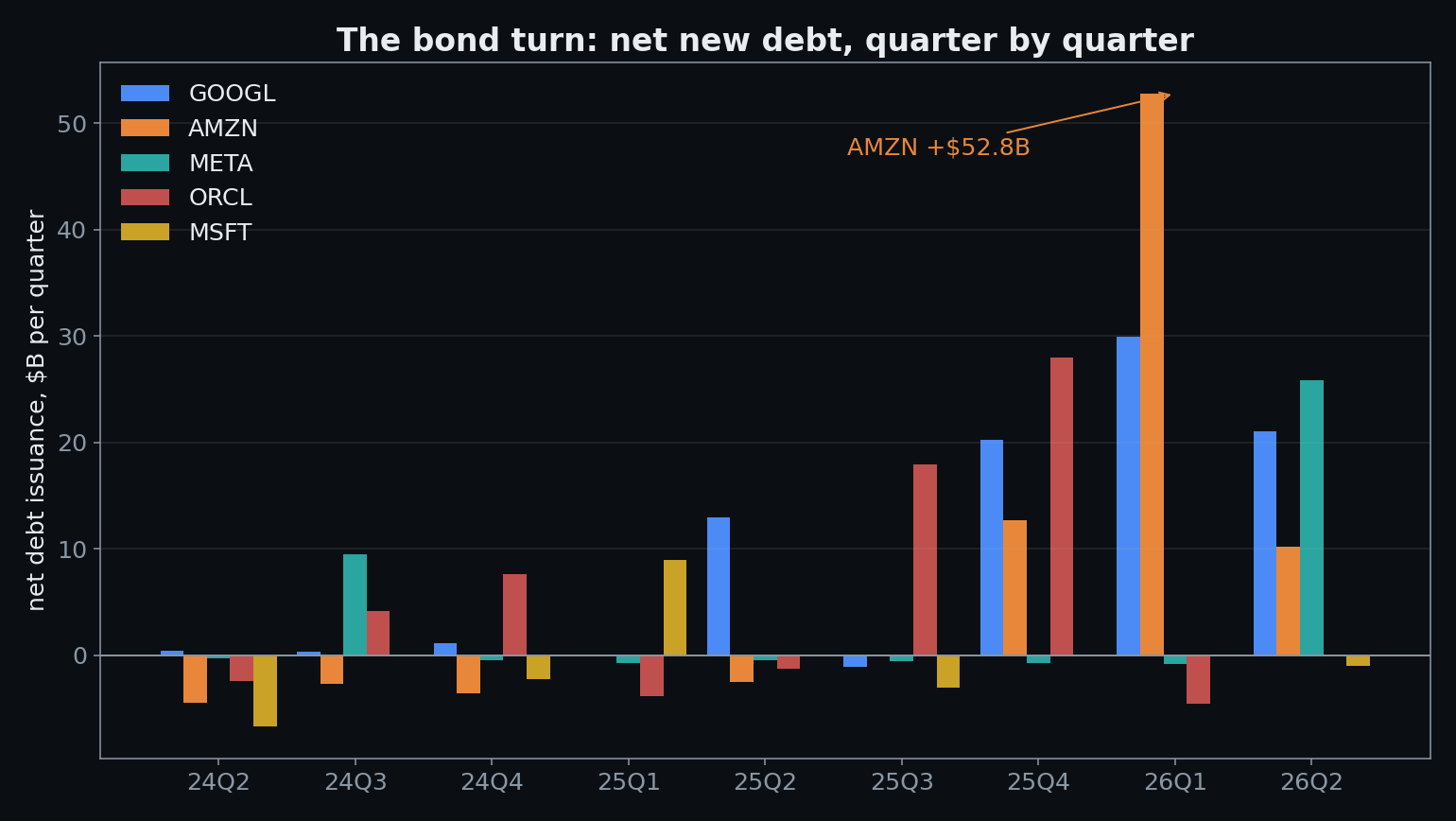
The same statements show where the cash flow went instead — and where new cash came from.
Amazon's 10-Q states it plainly: proceeds from debt were $82.4 billion in the first half of 2026, against $4.7 billion in the first half of 2025 — a seventeen-fold increase — including a single quarter, Q1 2026, with roughly $53 billion of net new borrowing. The filing adds, in words rather than numbers: "We expect to undertake additional financing activities in 2026."
Alphabet's financing section is the most remarkable reversal in the group. In the first half of 2025, Alphabet used $26.0 billion of cash in financing activities — the familiar pattern of a company returning capital. In the first half of 2026, financing activities provided $86.3 billion. Gross debt issuance ran at $56.2 billion with only $5.3 billion of repayments.
Meta issued $29.9 billion of long-term debt in 2025 — its largest bond program ever at the time — and followed it with $24.9 billion more in the first half of 2026.
Oracle issued $46.1 billion of senior notes and term loans in the fiscal year ended May 2026, up from $19.5 billion the year before and zero the year before that.
Not just bonds: the equity surprise
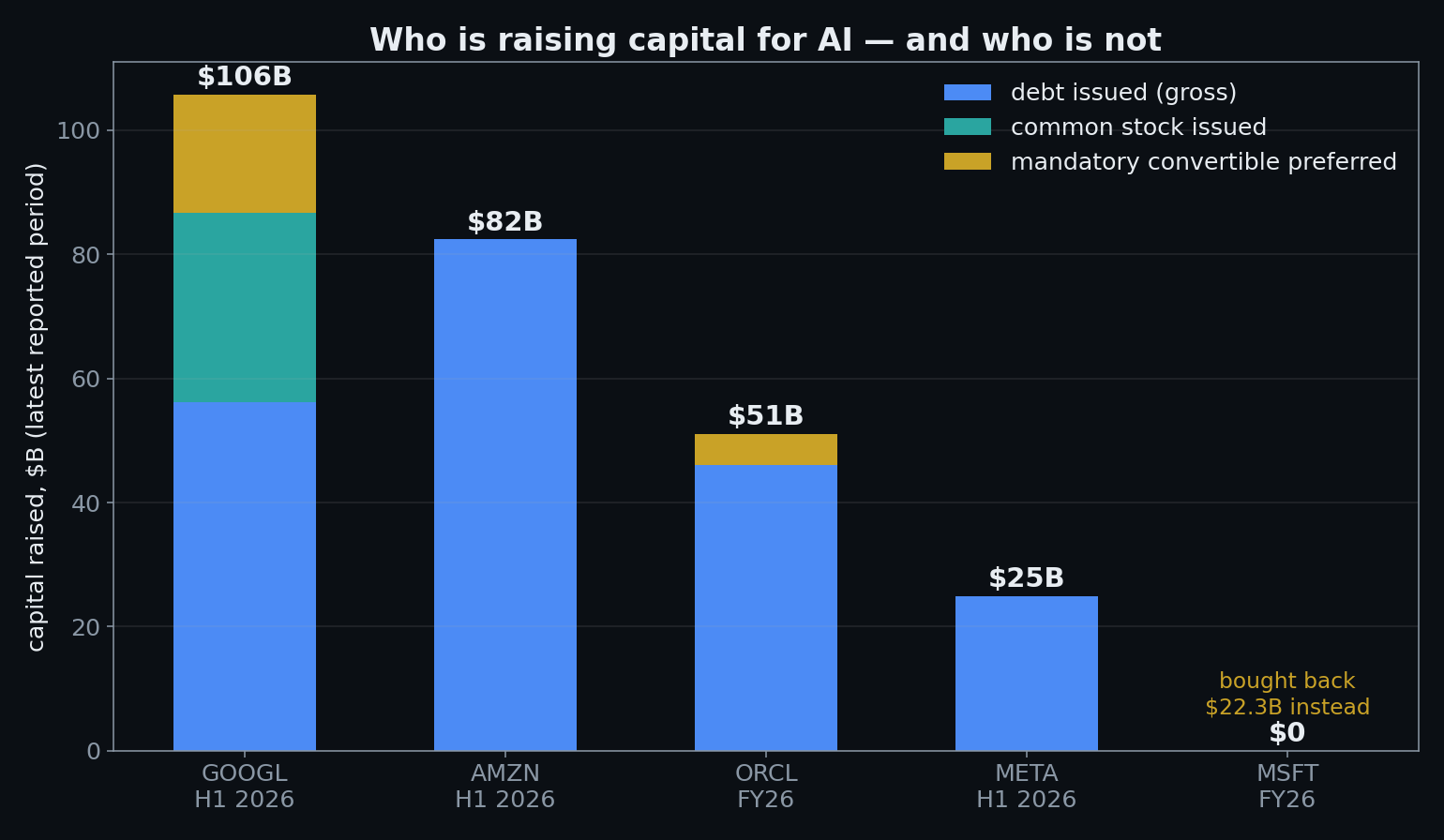
The bond story is only part of the funding stack. Two details in the 2026 filings deserve more attention than they have received.
First, Alphabet — the company that retired $28 billion of its own shares in the first half of 2025 — issued $30.5 billion of common stock in the first half of 2026, plus $19.1 billion of mandatory convertible preferred. Add the debt and Alphabet raised roughly $106 billion in six months. A management team that was a net buyer of its own equity at lower prices is now a net seller at higher ones. That is a filed statement about how the company weighs its own cost of capital, whatever the press releases emphasize.
Second, the mandatory convertible preferred is becoming a pattern: Oracle placed $4.95 billion of the same instrument in fiscal 2026. Preferred of this kind is equity that pays a coupon — capital that does not show up in the bond tallies but is not free either.
The flip, company by company
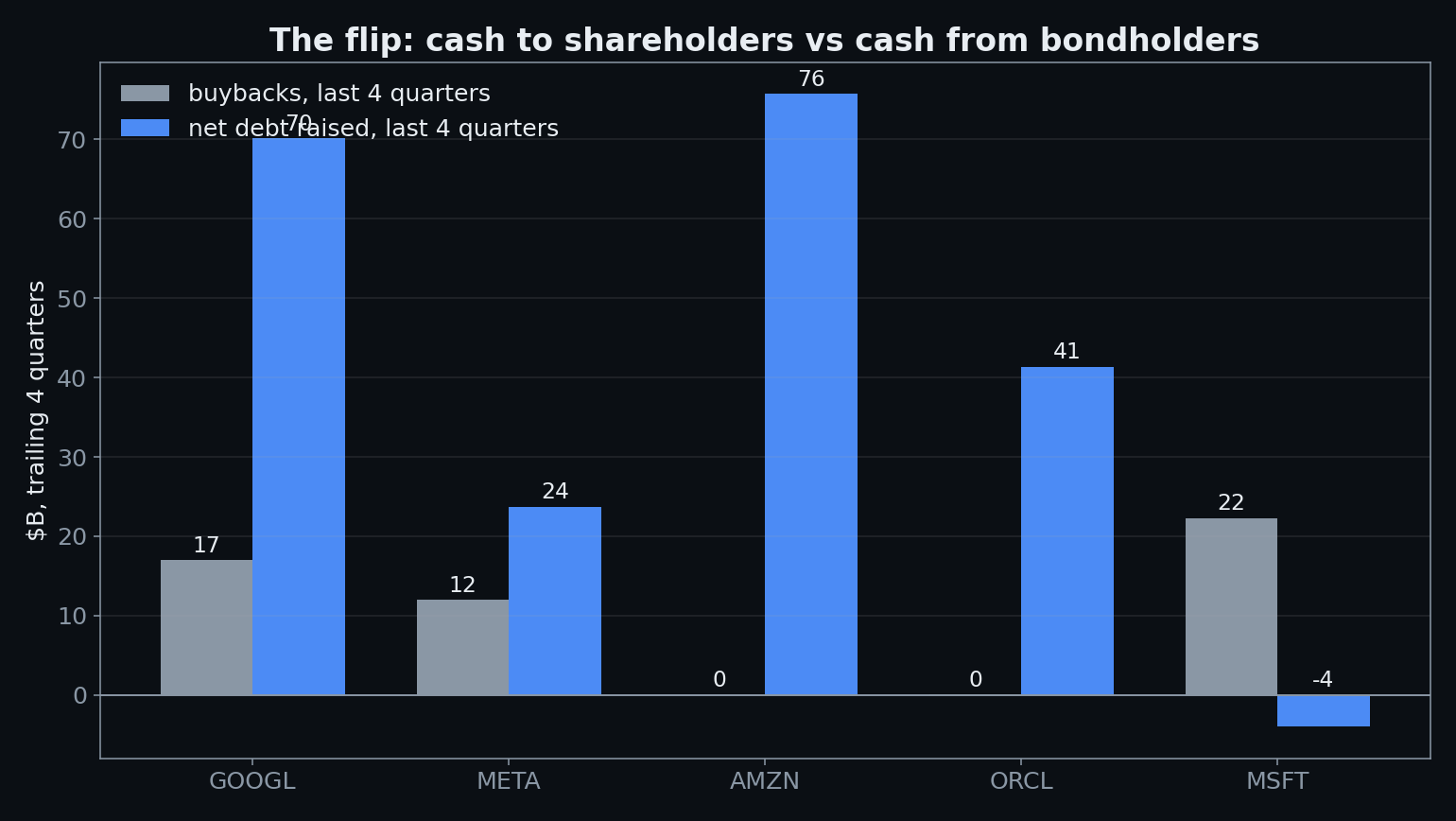
Over the trailing four reported quarters, net new debt raised was roughly $70 billion at Alphabet, $76 billion at Amazon, $41 billion at Oracle, and $24 billion at Meta — about $210 billion across the four — while their combined buybacks fell toward a few billion and, at three of them, to zero.
The Microsoft exception
Microsoft's fiscal-2026 cash-flow statement shows no proceeds from long-term debt issuance at all — while repaying maturities on schedule — alongside the steady $22.3 billion of repurchases and $26.4 billion of dividends. Whatever share of the AI buildout Microsoft is funding, it is funding out of operating cash flow, the way all five used to. It is now the only member of the group for which that sentence is true.
What a filed reader takes from this
The point here is not that debt is bad. At these ratings, this is some of the cheapest corporate borrowing on earth, and the companies doing it generate enormous operating cash. The point is that the capital-return era ended in the filings before it ended in the narrative. Buybacks were the visible sign that these businesses produced more cash than they could use. That sign has now inverted at three of the five: the same cash-flow statements that once recorded $15 billion a quarter of repurchases now record $20, $30, $50 billion a quarter of new paper — and, at Alphabet, new shares.
Two things are worth watching in the next round of 10-Qs. Interest expense, which compounds quietly while capex headlines get the attention. And the buyback lines themselves: whether Meta's and Alphabet's zeros are a pause or a policy. The filings will say before the press releases do.
Alphabet: 0001652044-26-000071
(sec.gov) ·
Amazon: 0001018724-26-000026
(sec.gov) ·
Meta: 0001628280-26-050705
(sec.gov) ·
Oracle: 0001193125-26-277521
(sec.gov) ·
Microsoft: 0001193125-26-323660. Quarterly chart series from the filed
quarterly cash-flow statements. Research, not investment advice.
Working with this data from an AI agent? The EvidInvest MCP server gives Claude, Cursor, and any MCP client access to 46 financial data, valuation, and SEC intelligence tools.
Fair Value Weekly
Get DCF breakdowns, fair value updates, and portfolio ideas for serious investors. No spam, no paywalled teasers.