
The trillion dollars that isn't on any balance sheet: mapping hyperscaler shadow debt, LLC by LLC
Figures trace to: Meta 10-K 0001628280-26-003942 and 10-Qs 0001628280-26-028526 / 0001628280-26-050705; Microsoft 10-K 0001193125-26-323660; Alphabet 10-Q 0001652044-26-000071; Amazon 10-Q 0001018724-26-000026; Oracle 10-K 0001193125-26-277521; Blue Owl Real Estate Net Lease Trust 10-Qs (CIK 1944366); deal terms from IFR, Bloomberg, S&P and issuer releases as cited. The Silicon Valley 101 documentary on this topic prompted the dig; every number below was independently re-verified against the primary source, and several were corrected. Research, not investment advice.
Last week we wrote that the hyperscalers flipped from buybacks to bonds — roughly $210 billion of debt raised in their latest reported periods. That number is real. It is also the visible layer. Underneath the bond tallies sits a second architecture of special-purpose vehicles, residual-value guarantees, credit backstops booked as derivatives, finance leases filed under "other liabilities," and — the largest single item — $1.09 trillion of signed data-center leases that have not commenced and therefore appear on no balance sheet at all.
The Bank for International Settlements has a name for this: shadow borrowing (BIS Quarterly Review, March 2026). The name sounds like an accusation. It isn't one — every structure below is legal, rated, audited and disclosed. But it is complex by design, and the complexity has a purpose. Below is the map, company by company, entity by entity, with the actual lenders named where they are disclosed — and then the honest question: is this hidden leverage, or is this simply what financing looks like when an industry needs more capital than any balance sheet was built to carry?
The scoreboard first
| Bonds raised, latest period | Recognized lease liabilities | Signed, NOT yet on balance sheet | |
|---|---|---|---|
| Microsoft | $0 | $88.5B ($66.6B finance + $21.9B operating) | $329.1B |
| Meta | $24.9B (H1'26) + $39.8B via SPVs | (leases on book) | $278.99B |
| Oracle | $46.1B (FY26) | $37.9B | $260B |
| Amazon | $82.4B gross (H1'26) | ~$110B+ | $137.2B |
| Alphabet | $56.2B gross (H1'26) | $20.6B | $85.2B + $43.8B backstop notional |
Uncommenced leases across the five: ~$1.09 trillion, against roughly $285 billion of lease liabilities actually recognized. Under lease accounting this is legal and disclosed — in the footnotes. A lease that has not commenced books nothing, however binding the signature.
Meta: the Beignet machine
The cleanest case study in the group, because the bond documents leaked into the rating agencies' and one lender's own filings.
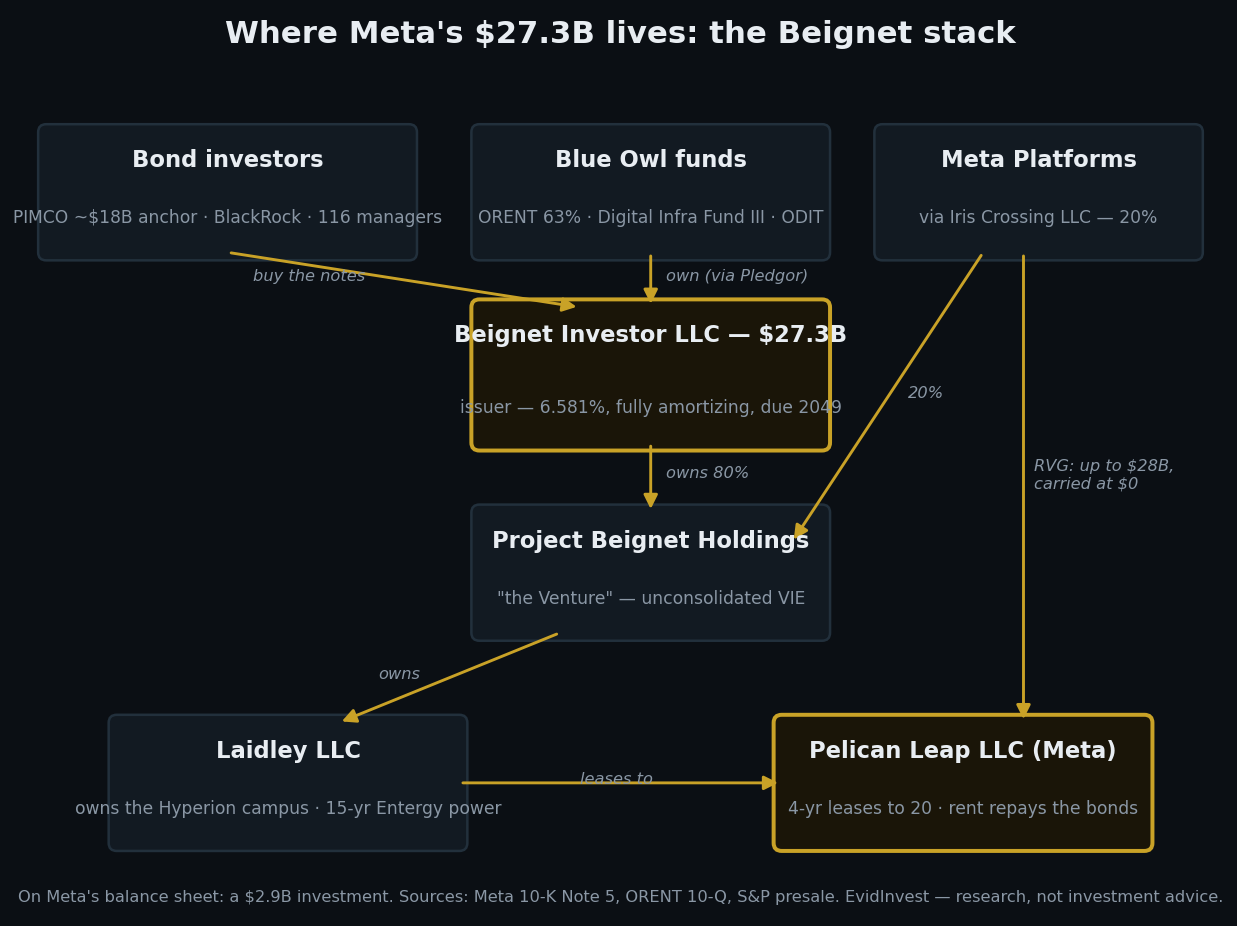
Meta's Hyperion campus in Richland Parish, Louisiana is financed by $27.294 billion of privately placed senior secured notes — 6.581%, fully amortizing, due May 30, 2049 — issued in October 2025 by an entity called Beignet Investor LLC. None of that debt is on Meta's balance sheet. What Meta carries instead is an equity-method investment of $2.92 billion (June 30, 2026 — it was $1.83B at year-end, $2.37B in March; the venture keeps calling capital).
The chain, reconstructed from S&P's presale, the Blue Owl Real Estate Net Lease Trust's own 10-Q, and Meta's Note 5:
- Laidley LLC owns the campus and holds 15-year power agreements with Entergy Louisiana.
- Project Beignet Holdings LLC owns Laidley. This is "the Venture."
- Beignet Investor LLC owns 80% of Holdings and issued the $27.3B.
- Beignet Pledgor LLC owns the issuer and pledged that equity to the trustee — the bondholders' collateral is the SPV stack itself.
- Above Pledgor: funds affiliated with Blue Owl Capital — its non-traded net-lease REIT (ORENT, which disclosed a 63% indirect stake in the issuer at close for a $1.533B commitment), its $7B Digital Infrastructure Fund III, its Digital Infrastructure Trust, plus undisclosed co-investors.
- Meta's 20% sits in a Meta subsidiary named Iris Crossing LLC — the entity that also posts Meta's guarantee.
- A Meta subsidiary named Pelican Leap LLC leases the eleven buildings back on four-year triple-net terms renewable to twenty years, starting 2029. Initial lease commitment: $12.31 billion.
Why doesn't Meta consolidate a venture whose buildings it designed, constructed (it provides construction management, administrative and property management services), leases entirely, and guarantees? Because under the VIE rules the "activity that most significantly impacts the Venture's economic performance" was determined to be remarketing the campus — deciding what happens if Meta ever leaves — and that power belongs to Blue Owl. Meta is therefore "not the primary beneficiary." Its auditor EY flagged exactly this consolidation judgment as a Critical Audit Matter in the FY2025 10-K.
And if Meta leaves? The leases run four years against 24-year debt. The bridge is a residual value guarantee with an aggregate threshold of approximately $28 billion, declining over time, covering the first 16 years (a termination fee covers the rest). Meta's filing then delivers the sentence that makes the whole structure work: "RVG payments are not probable, and therefore no liability has been recorded." Meta's own disclosed maximum exposure to loss: $46.03 billion — against a $2.92 billion carrying value.
The lenders: PIMCO anchored ~$18 billion of the notes (after beating Apollo and KKR for the mandate, per Bloomberg); BlackRock took $3B+; per S&P Capital IQ data cited by the FT, 116 managers across 384 funds hold the paper — PGIM, Natixis, T. Rowe, Invesco, Fidelity, JPMorgan — with insurance and retirement money throughout. Morgan Stanley was sole bookrunner. S&P rates the bonds A+, one notch below Meta's AA– — the market prices it as Meta risk with a haircut, whatever the org chart says.
Deal two, "Sopaipilla" (El Paso, ~1GW, ~$14B campus): $12.547 billion priced July 27, 2026 at 7.534%, due 2048 — a full 62.5bp wider than Beignet priced, and demand was soft. Same 80/20 anatomy, but the 80% is BlackRock — specifically its GIP infrastructure-equity and HPS private-credit arms — with J.P. Morgan joining Morgan Stanley on the books. Meta's RVG this time: ~$13 billion, disclosed as a subsequent event in the Q2 10-Q. Two SPV bonds in nine months: $39.8 billion of debt that services Meta data centers and appears on no Meta balance sheet. Meanwhile Hyperion itself has been expanded to a 5GW, $50B+ program — the obvious candidate for pastry number three.
For calibration: Meta paid roughly 6.58% via Beignet when its own public curve was near 5.5%. On $27.3B that is close to $300 million a year of extra interest, paid for balance-sheet cosmetics.
Microsoft: the lease ledger
Microsoft has issued no new public bonds since 2021, and its reported debt fell to ~$40 billion. Our last piece called it the only hyperscaler funding the buildout from operating cash. That was the visible layer.
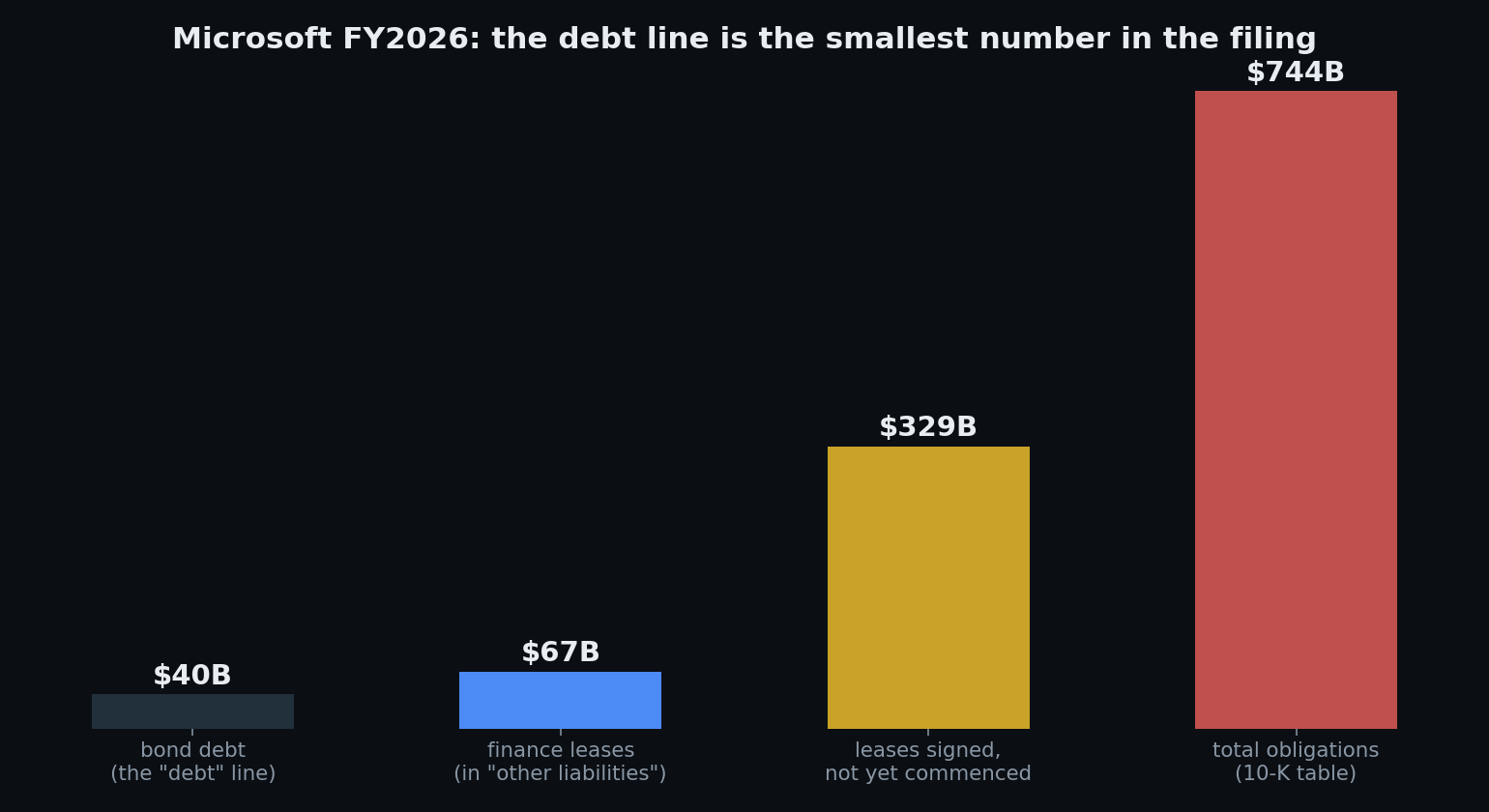
From the FY2026 10-K: finance lease liabilities of $66.6 billion, up from $46.2 billion a year earlier — recorded not on the debt line but inside "other current liabilities" ($4.3B) and "other long-term liabilities" ($62.3B). Total lease payments committed under finance leases: $89.7 billion. Weighted average term: 13 years. These are mortgages in everything but name — and they are one and a half times the bond debt.
Then the footnote that resets the scale: "As of June 30, 2026, we had additional leases, primarily for datacenters, that had not yet commenced of $329.1 billion." Commencing fiscal 2027 onward. Not a dollar of it recognized yet — over $130 billion of it added in the June quarter alone, per Bloomberg's tally.
Who owns the buildings? Microsoft doesn't say. Publicly known counterparties: $60B+ of neocloud capacity commitments (Nscale ~$23B, Nebius $17–19B, IREN $9.7B, CoreWeave, Lambda), the traditional landlords (Blackstone's QTS, KKR/GIP's CyrusOne, Brookfield's Compass, DigitalBridge/Silver Lake's Vantage), and its own AI Infrastructure Partnership with BlackRock/GIP and Abu Dhabi's MGX — a $30B equity / $100B-with-debt vehicle that has already acquired Aligned Data Centers for ~$40 billion.
Two more FY26 details complete the picture. Commercial paper is back on the balance sheet ($6.7B short-term debt). And in July Microsoft announced that from FY2027 datacenter depreciation stretches from 15 to 25 years and more future leases will classify as operating rather than finance leases — which pulls them out of reported capex, trimming the FY2027 plan from ~$190B to ~$175B without changing a dollar of actual spending.
Alphabet: selling insurance instead of borrowing
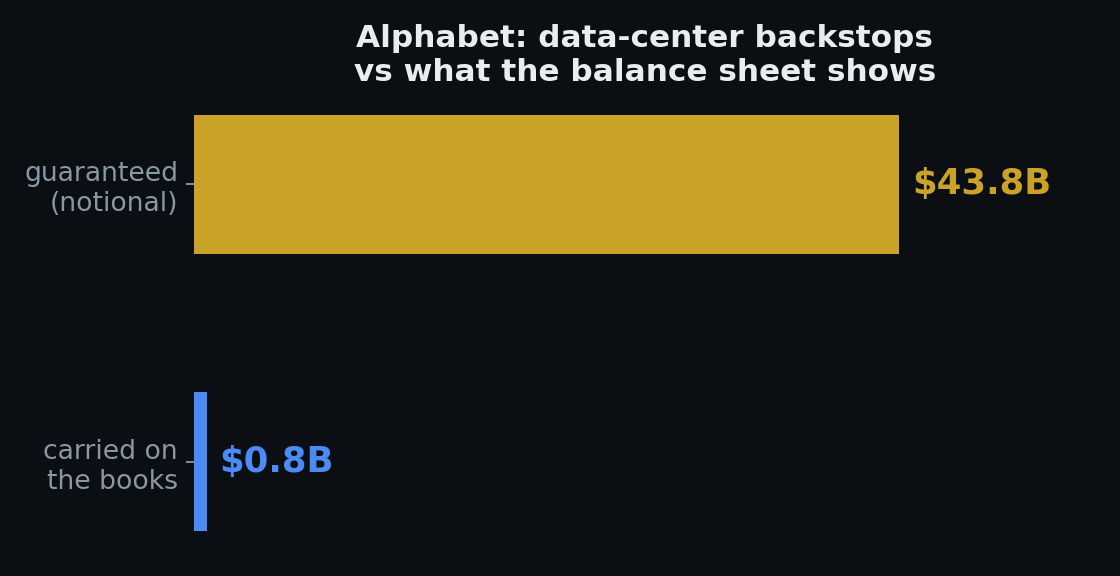
Alphabet's method is the most creative: it doesn't borrow for third-party capacity, and mostly doesn't own it — it guarantees other people's debt so that they can borrow to build capacity Alphabet's ecosystem needs. In the filings these backstops are booked as credit derivatives: notional up from $16.9 billion at year-end to $43.8 billion at June 30, 2026 — carried on the balance sheet at $815 million, under 2% of the exposure. Terms run up to 15 years, and on a default Alphabet can step into the underlying lease. On top: $7.6B of supplier backstops for long-lead power equipment and another $24.1B of backstops agreed but not yet finalized.
Where the guarantees point (all disclosed via the counterparties, not
by Alphabet): the Fluidstack web serving Anthropic's TPU capacity —
TeraWulf's Lake Mariner buildout (a $3.2B Morgan Stanley construction
bond exists because Google backstops the leases; Google took warrants
for 14% of TeraWulf), Cipher Mining's Barber Lake ($1.4B backstop,
$1.8B). And in June 2026 the structure went industrial-scale: a $35
billion financing for Anthropic's five-site TPU expansion, led by
Apollo with Blackstone, underwritten not against Anthropic but
against Google's backstop of the lease payments. As one project-finance
analyst put it: "The lenders are not underwriting Anthropic. They are
underwriting Google."5.4% warrants), TeraWulf Abernathy ($1.3B), Fluidstack directly
(
Amazon: the honest borrower, mostly
Amazon does it the old way: in its own name. The March 2026 offering — $37B in dollars plus €14.5B — was the largest corporate bond sale in history, followed by C$14B in June and $25B more in July: over $72 billion of 2026 issuance, all on balance sheet, with the 10-Q stating plainly that more financing should be expected. Alongside that: $137.2 billion of not-yet-commenced leases (it was $106B one quarter earlier) and $130B of unconditional purchase obligations. Even the "honest" one carries a quarter-trillion of committed spend beyond its bonds.
Oracle: the biggest bet on the thinnest base
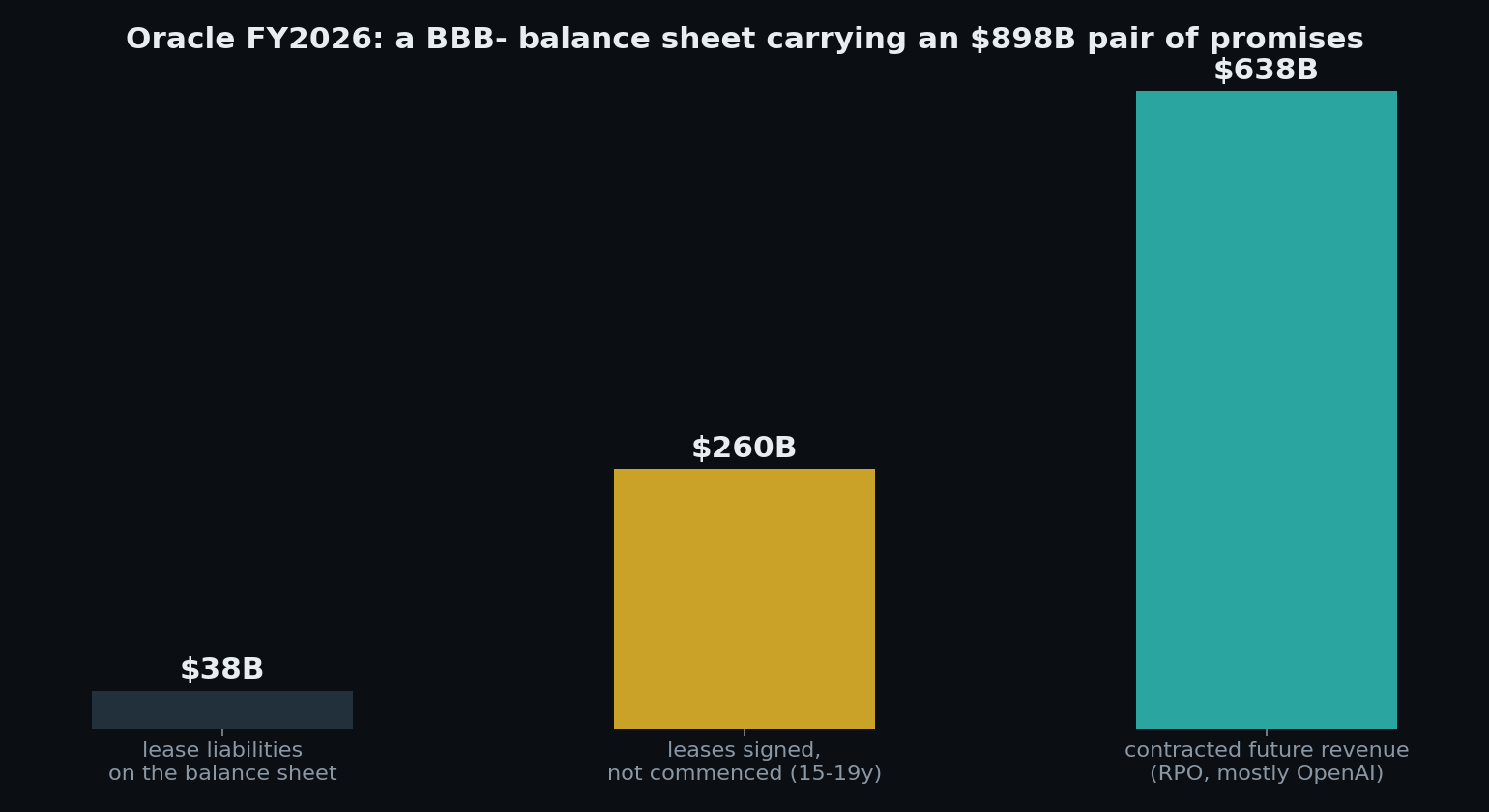
Oracle signed $260 billion of data-center lease commitments — fifteen-to-nineteen-year terms, substantially all commencing fiscal 2027–2029, none of it on the balance sheet (recognized lease liabilities: $37.9B). Buried in the same note: Oracle guaranteed up to $3.3 billion of one lessor's own borrowing — the Alphabet technique, appearing at the company least able to afford it. Remaining performance obligations jumped from $138B to $638 billion in one year — overwhelmingly OpenAI's Stargate commitments. S&P cut Oracle to BBB– in July; its five-year CDS traded at ~203bp, the widest since the financial crisis.
Who actually owns Oracle's Stargate shells: Crusoe with Blue Owl and Primary Digital at Abilene ($15B JV); Vantage (DigitalBridge/Silver Lake) at the Texas "Frontier" and Wisconsin campuses, financed by a $38 billion JPMorgan + MUFG debt package — the largest data-center debt raise on record; Related Digital with Blackstone equity and ~$10B of PIMCO anchor debt in Michigan — a deal Blue Owl declined on underwriting standards and PIMCO took anyway; Blue Owl again in New Mexico ($18B).
Why none of this counts as debt: the five doctrines
Every structure in this piece leans on one of five accounting rules. None of this is fraud; all of it is disclosed — in footnotes. The rules:
1. The lease-commencement rule (ASC 842). A signed lease books nothing until the asset is delivered. Sign $329 billion of 20-year datacenter leases that start next year and your balance sheet today records zero. This single rule carries the $1.09 trillion.
2. The VIE primary-beneficiary test (ASC 810). You consolidate a special-purpose entity only if you have "power over the activities that most significantly impact its economic performance." Meta designs, builds, operates, fully leases and guarantees Hyperion — but "remarketing the campus" was designated the most significant activity, Blue Owl holds that power, so $27.3B of debt lands on nobody's consolidated books but the SPV's own.
3. Guarantee fair-value accounting (ASC 460/815). A guarantee is carried at what it is "worth" today — the probability-weighted expected payment — not at what you would owe if called. Alphabet's $43.8B of backstop notional carries at $815M. Meta's $28B RVG carries at zero, because payment is "not probable."
4. Lease classification (ASC 842 again). A finance lease is debt in substance but is presented in "other liabilities," not the debt line — Microsoft's $66.6B. And an operating lease books only the present value of committed rent — Meta's 4-year lease terms against 24-year SPV debt book $12B against $27B, with the RVG (carried at zero) bridging the gap. Reclassify future leases from finance to operating, as Microsoft will from FY2027, and reported capex falls with no change in cash spent.
5. The failed-sale-leaseback doctrine (ASC 842-40) — the one that bites back. If a "lease" transfers the asset's economics to the lessee, auditors must recharacterize it as a loan. This is the rule SpaceX just collided with, below — proof that the perimeter of these structures is a judgment call an auditor can reverse.
The Musk complex: where the structure got recharacterized
The same architecture reached Elon Musk's companies with less polish and more leverage — and produced the one case where an auditor pushed the debt back on-book.
The GPU SPV. xAI's Colossus buildout is financed through Valor Compute Infrastructure L.P. — a fund run by Valor Equity Partners (Antonio Gracias, SpaceX director and, through Valor entities, holder of 500M+ SpaceX Class A shares). The design mirrors Beignet, with GPUs instead of buildings: the SPV raises equity and debt (~$7.5B/$12.5B program target), buys NVIDIA GB200/GB300 systems, and leases them to xAI's datacenter subsidiary CTC Property LLC on 5-year triple-net terms with a purchase option. Three lease tranches (October 2025, January 2026, April 2026) total roughly $20 billion of undiscounted obligations, guaranteed by SpaceX.
The financing chain is a closed circle worth drawing: NVIDIA is the anchor equity investor (~$1.9–2B) in the SPV that buys NVIDIA's chips — the vendor capitalizing its own customer and booking the revenue. Apollo provided $3.5B of the debt in the January tranche, reportedly routed onward into Athene, its annuity insurer — retirement money, again. Diameter Capital took part of the debt. Michael Burry called the structure "fugazi"; Apollo called it "downside-protected."
Then the auditor arrived. In SpaceX's IPO filings, PwC concluded the Valor arrangements were failed sale-leasebacks — "loans in substance, not leases" — and roughly $9.0 billion of related-party debt to Valor went ON SpaceX's balance sheet, with the GPUs staying in property and equipment. It is the only structure in this piece that an auditor has so far refused to leave outside the perimeter — a useful benchmark for what Beignet would look like if the judgment call ever went the other way. The related-party geometry is also the sharpest in the industry: SpaceX's GPU lessor is one of its largest shareholders, sits on its board — and, as we showed in our SpaceX 13F census, is the second-largest institutional holder of the stock at $86 billion.
The rest of the Musk stack, briefly: legacy xAI corporate debt cost 12.5% (since refinanced through a $20B Goldman bridge and ~$25B of post-IPO SpaceX senior notes); the Memphis turbine fleet is financed at 9.85% through Stonebriar and housed in Stateline Power LLC, a 50.1/49.9 JV with Solaris that Solaris consolidates and SpaceX equity-methods — 900MW of power plant off SpaceX's balance sheet, the Meta trick at utility scale. Against all this sit the compute-rental contracts that service the leases: Anthropic at $1.25B/month through May 2029 (~$45B), Google at $920M/month, Reflection AI at $150M/month. For price calibration across the piece: Meta's SPV money costs ~6.6%, Oracle's public money ~5–6%, Musk's stack ran 9.85–12.5% before the IPO laundered it into investment-grade curves. Same machine, three price tiers of the same collateral idea.
The lender web, and who holds the bag
Rearrange the deals by financier and the names repeat: Blue Owl (Meta Hyperion, Stargate Abilene and New Mexico), PIMCO (Meta anchor, Oracle Michigan), Blackstone (QTS, Michigan equity, the Anthropic loan), BlackRock/GIP/HPS (Sopaipilla, Microsoft's AIP, Aligned), Apollo (Anthropic lead), KKR (CyrusOne), Brookfield (Compass), with JPMorgan, MUFG and Morgan Stanley arranging. NVIDIA appears on both sides: anchor equity in the xAI GPU SPV, and in August 2026 it formalized the club: a compute-financing platform with Apollo, BlackRock, Blackstone, Brookfield, Goldman Sachs and KKR targeting $500 billion of third-party capital, with NVIDIA offering residual-value support of up to 25% on select deals — the chip vendor now underwriting the resale value of its own chips, exactly as Meta underwrites the resale value of its own data centers.
Behind the asset managers, the money is insurance float, pensions, and retail semi-liquid funds. Which is why the stress signals matter: Blue Owl's non-traded credit funds took redemption requests of 19–41% of NAV in the first half of 2026 against 5% quarterly gates, and the firm sold $1.4B of assets to fund withdrawals. The data-center ABS market — securitized rents — has grown from $4B in 2020 to ~$61 billion. The US Office of Financial Research and the FSB have both flagged the interconnection; Senators have asked FSOC to examine the Meta structure specifically.
The other side: why they can't just issue bonds
It is tempting to read all of this as concealment. The fuller reading is that the ordinary tool — a corporate bond on the issuer's own balance sheet — simply cannot carry this buildout, for four reasons the deal flow makes visible.
The market has a ceiling. Order books are already thinning: Amazon's oversubscription fell from 5.3x to 1.6x in nine months; new-issue concessions across the sector went from ~2 basis points to ~12; Meta's second SPV deal needed a 62.5bp wider spread than its first. Morgan Stanley puts data-center capex at ~$2.9 trillion through 2028, of which ~$1.5 trillion needs external money. The investment-grade bond market digests a few hundred billion of net new tech paper a year at best. The money has to come from somewhere else — and "somewhere else" is insurance and pension capital that wants exactly what these structures manufacture: long, amortizing, asset-backed, investment-grade paper.
The tenor has to match the asset. A data center earns over 15–25 years. Public bond curves get expensive and thin past 10–15 years; a fully amortizing 24-year private placement wrapped around a specific building with a specific tenant is, mechanically, a better-matched instrument than a bullet bond — it is how toll roads, pipelines, and power plants have been financed for decades. Project finance did not become respectable by accident.
Ratings are a hard budget constraint. Oracle put the buildout on its own balance sheet — the "honest" route — and got downgraded to one notch above junk, with CDS at 18-year wides. The downgrade is not cosmetic: it shrinks the eligible buyer base for every future bond. Keeping the debt in rated SPVs preserves the parent's rating capacity, which is the capacity to keep building.
And investor mental models break. These companies traded for a decade as "net cash, high buyback, capital-light." Piling $300 billion of construction debt onto that picture doesn't just move ratios — it evicts the shareholder base that owns the stock for that picture, before a new base has priced the new reality. CNBC called the buyback cut a breach of an "unspoken contract." The SPV architecture is, in part, a managed transition between those two shareholder bases.
This is how the financial system has always metabolized a capital super-cycle — railroads invented modern project finance, real estate invented the REIT, mortgages invented securitization. AI compute is inventing its instrument set in real time: SPV net-lease bonds, GPU funds, compute-backed credit. The evolution is legitimate. What deserves scrutiny is not that the structures exist, but that the headline numbers most investors read do not add them up — and that the risk, carefully carved out of every balance sheet, has not disappeared. It has moved: into rents, guarantees, and residual values, payable only in the world where AI demand stalls.
How big is that risk, and what would it take to trigger it? GPU lending rates falling from 15% to under 6% in three years say the market believes compute has become a durable asset class — NVIDIA now finances it like real estate. Whether that belief survives its first recession is the subject of our next piece.
What this does to our buybacks piece
Our previous analysis stands, but its scale was conservative and one conclusion needs sharpening. The ~$210B of bonds is the smallest of three layers: above it sit the on-book-but-not-called-debt items (Microsoft's $66.6B of finance leases, Alphabet's $43.8B of guarantee notional carried at $815M), and above those the $1.09 trillion of signed leases that accounting does not yet see — plus $39.8B of SPV bonds and $41B of RVG exposure at Meta alone. And Microsoft is not the unlevered exception — it is the differently levered exception: no bonds, but the group's single largest pile of future lease commitments and a doubling finance- lease book. Funding "from operating cash" today, having promised $329 billion of tomorrow's.
The capital-return era did not just end. It has been replaced by the most elaborate corporate financing architecture since the GSE era — rated, documented, legal, disclosed in footnotes, and largely invisible in every headline debt number you will read this earnings season.
Research, not investment advice. Not a price call.
Working with this data from an AI agent? The EvidInvest MCP server gives Claude, Cursor, and any MCP client access to 46 financial data, valuation, and SEC intelligence tools.
Fair Value Weekly
Get DCF breakdowns, fair value updates, and portfolio ideas for serious investors. No spam, no paywalled teasers.