
NVIDIA reports Wednesday. The real event is an exhibit, not a number.
Figures trace to NVIDIA's Q1 FY27 10-Q (accession 0001045810-26-000052,
quarter ended 2026-04-26, filed 2026-05-20) and the August 17 8-K
(accession 0001045810-26-000069). We do not quote street consensus —
only what is filed. Research, not investment advice.
NVIDIA ($NVDA) reports fiscal Q2 2027 on Wednesday, August 26, after the close. The stream will watch one revenue number. The filing that lands with it contains five things that matter more.
1. The $105B fine print goes public
The August 17 8-K disclosed residual-value guaranties capped at $105 billion backing OpenAI's leases at the Portsmouth campus — and stated that the form of the agreements files as an exhibit to this 10-Q. That means Wednesday is the first time anyone outside the deal sees:
- the guaranteed minimum value per lease — the number the $105B cap protects, which the 8-K deliberately did not disclose;
- how the cap is allocated across leases;
- the credit-rating test that releases NVIDIA from the obligation.
We wrote up the 8-K itself and, this weekend, the industry-wide architecture it belongs to — the same residual-value-guarantee instrument Meta uses to keep $27B off its balance sheet. Wednesday, NVIDIA's version gets its fine print.
2. Concentration: who is the revenue?
Last quarter, two direct customers were 16% and 14% of total revenue. In the year-ago quarter it was 23% and 16%. The 10-Q also carried this sentence, easy to miss: "We estimate that one AI research and deployment company contributed to a meaningful amount of our revenue by purchasing cloud services from our customers." The filing does not name the company. Watch whether that language sharpens, and whether the customer letters (A, B…) grow or shrink as Blackwell ships broaden.
3. The quiet geography flip
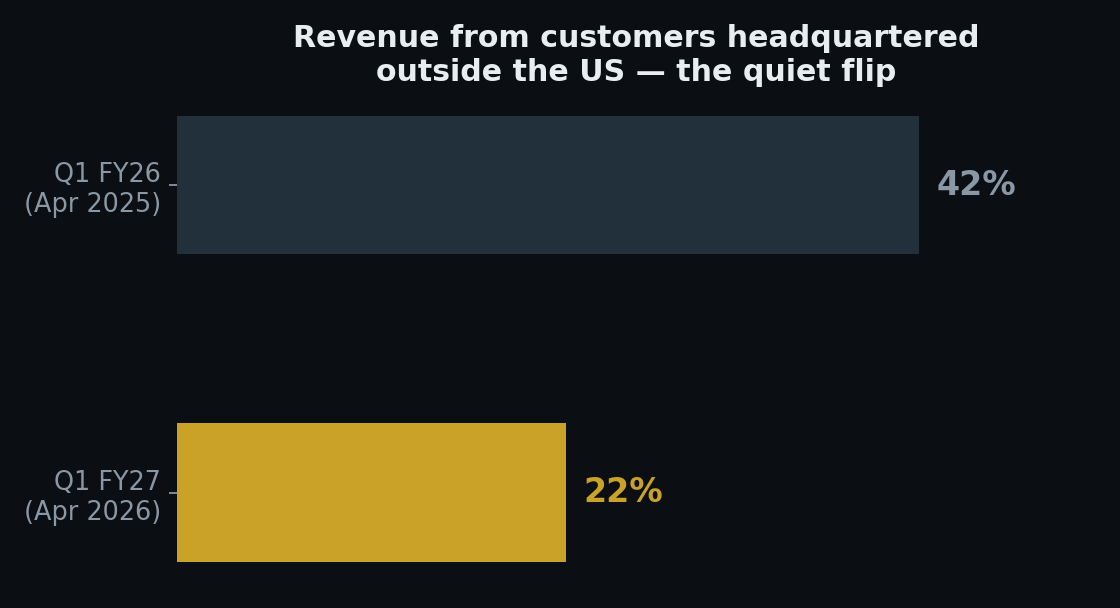
A year ago, 42% of quarterly revenue came from customers headquartered outside the United States. Last quarter: 22%. The AI buildout has concentrated NVIDIA's revenue into a handful of US hyperscalers and AI labs — the same names, as it happens, in our shadow-debt map. Wednesday shows whether that concentration deepened.
4. The balance sheet is becoming a portfolio
Between January and April, NVIDIA's non-marketable securities jumped from $22.3 billion to $43.4 billion and marketable equity securities from $12.9 billion to $30.2 billion — the vendor is becoming one of the largest investors in its own customer base. Add the $105B guaranty and the announced compute-financing platform, and the income statement is only half the NVIDIA story now. Watch both investment lines, and the supply/purchase-commitment note beneath them.
5. The base it prints against
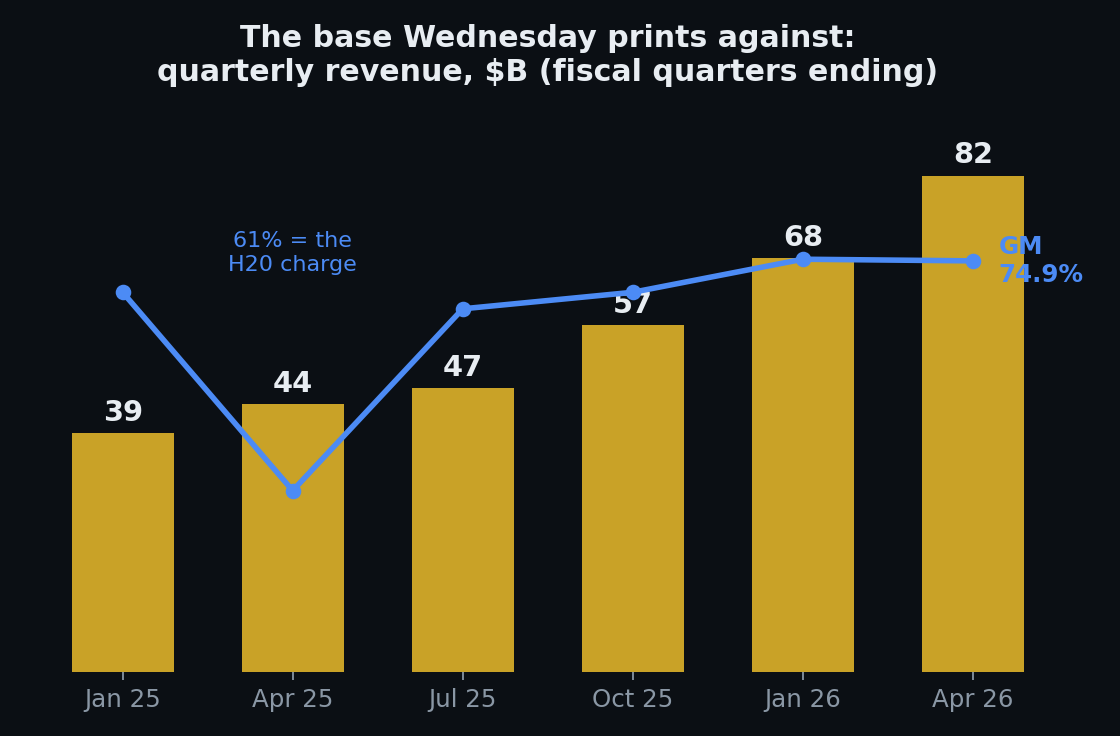
The filed trajectory: $39.3B → $44.1B → $46.7B → $57.0B → $68.1B → $81.6B over six quarters, with gross margin at 74.9% last quarter (the 61% dip a year ago was the $4.5B H20 charge, not operations). Net income last quarter was $58.3B — of which $15.9B was other income, largely those investment marks: worth separating when Wednesday's number lands.
Where we stand
Our seven-method, filed-fundamentals fair-value range for NVDA sits well below the market price — the top of the range near $132 against a $215 market. That is not a call on Wednesday; it is a measure of how much future growth is already paid for. The market is making a growth bet knowingly. The filing on Wednesday — the exhibit, the concentration letters, the geography line — is where you check whether the bet's assumptions are still being confirmed by what gets filed rather than what gets said.
We'll read the exhibit Wednesday night. The valuation model updates as the numbers land.
Sources: 10-Q 0001045810-26-000052
(sec.gov) ·
8-K 0001045810-26-000069
(sec.gov).
Research, not investment advice. Not a price call.
Working with this data from an AI agent? The EvidInvest MCP server gives Claude, Cursor, and any MCP client access to 46 financial data, valuation, and SEC intelligence tools.
Fair Value Weekly
Get DCF breakdowns, fair value updates, and portfolio ideas for serious investors. No spam, no paywalled teasers.